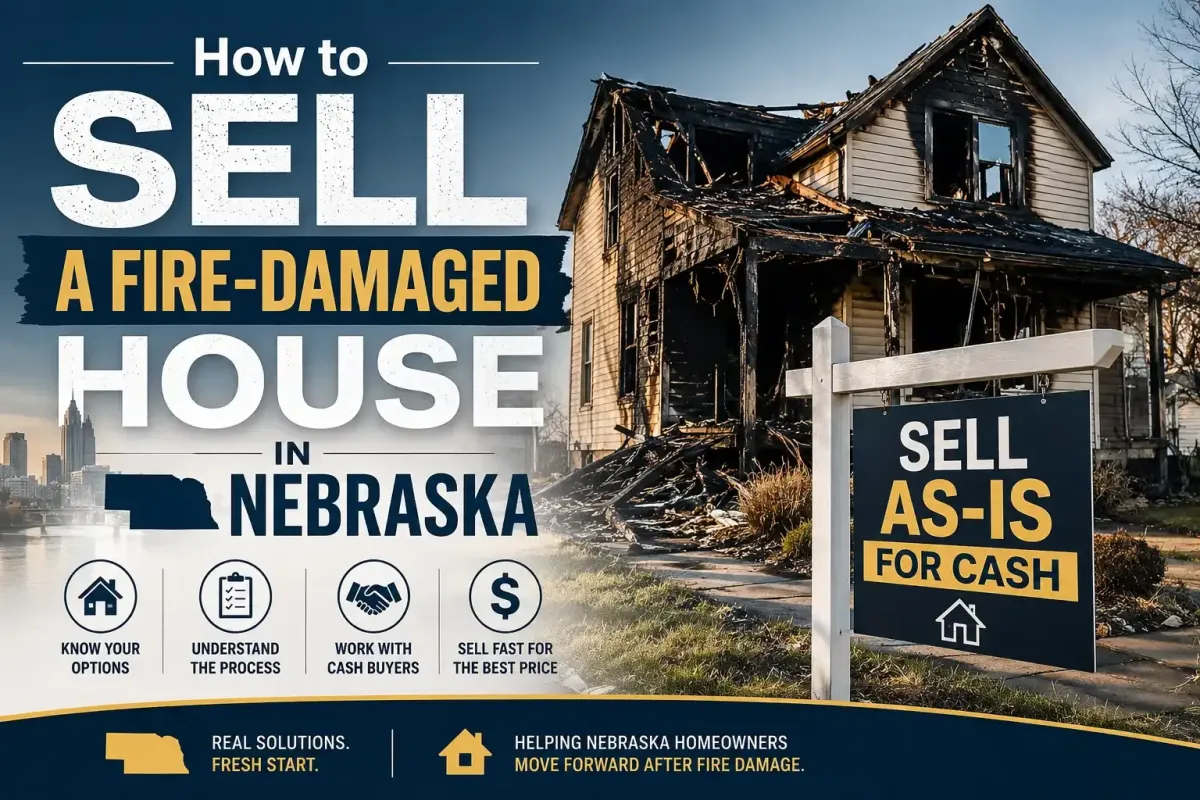
How to Sell a Fire-Damaged House in Nebraska | Fire Cash Buyer Guide
A house fire upends everything at once: your daily routine, your finances, your sense of security, and the future of the property you've spent years building equity in. If you're a Nebraska homeowner standing in front of a smoke-stained kitchen in Omaha, a charred attic in Lincoln, or worse, the question that hits hardest is usually the most practical one: what do I actually do with this house now?
The good news is that you have real, legitimate options. Whether the blaze was a small grease flare-up that left soot across the living room or a structural fire that took out half the second floor, selling a fire-damaged house is not only possible; Nebraska homeowners across the state successfully do it every single month. This guide walks you through every legitimate path forward, the exact disclosure law you must follow, what your home is realistically worth right now, and how to choose the option that matches your timeline, your finances, and your peace of mind.
By the end, you'll know exactly which of the four selling routes fits your situation and roughly what each one will put in your pocket once the dust settles.
Can You Sell a Fire-Damaged House in Nebraska?
Yes, you can absolutely sell a fire-damaged house in Nebraska, in any condition, at any stage of repair. No Nebraska law prevents the sale of a fire-damaged property. What state law requires is a full, honest, written disclosure of the damage to your buyer under Neb. Rev. Stat. § 76-2,120, which we'll break down in detail later in this guide.
Cash investors and house flippers who specialize in distressed properties and can close in 7–14 days
Owner-occupant rehab buyers using FHA 203(k) renovation loans that bundle purchase price and repair costs into a single mortgage
Land developers and builders purchase the lot for its raw value, but when structural damage makes a teardown the smartest play
The right path for you depends on three variables: the severity of the damage, your timeline, and how much capital you're willing to put into repairs before selling. Get those three factors clear in your head, and the decision becomes much simpler.
Fire Damage Severity: 4 Levels Nebraska Buyers Recognize
Before you choose any sales option, you need an honest, professional read on how bad the damage actually is. Most homeowners underestimate the damage because smoke, soot, and water from firefighting penetrate places you simply can't see. HVAC ductwork, wall cavities, attic insulation, and electrical wiring are all common hidden-damage zones.
Level 1 Cosmetic Smoke Damage
The fire was contained to a single appliance or a small area. Smoke residue on walls, ceilings, and fabrics. No structural impact. Typical Nebraska repair cost: $3,000–$8,000. The best path here is usually a traditional sale after professional cleaning and odor remediation.
Level 2 Moderate Surface Damage
Drywall, flooring, and cabinetry in one or two rooms need replacement. The HVAC system requires a deep clean, and you'll want an electrical inspection before closing. Typical Nebraska repair cost: $10,000–$30,000. Best path: cash sale as-is or repair-then-list, depending on how much equity you have.
Level 3 Major Structural Damage
Multiple rooms affected. Framing, subflooring, or roof trusses are compromised. Permits and licensed contractors required. Typical Nebraska repair cost: $35,000–$80,000. A cash buyer or land-value sale almost always nets you more than a do-it-yourself rehab attempt at this severity level.
Level 4 Total Loss
The home is uninhabitable. Demolition is likely required, and any rebuild starts essentially from the foundation up. Best path: sell as land or to an investor who specializes in teardown properties.
Expert insight: Get a professional damage assessment from a fire restoration specialist before you talk to a real estate agent or your insurance adjuster. Nebraska's State Fire Marshal report, required by State Statute 81-506, only documents the cause and origin of the fire. It does not give you a repair-cost estimate or a structural integrity opinion. You need both to make a smart decision.
4 Real Options for Selling a Fire Damaged Property in Nebraska
There are four legitimate paths for selling fire-damaged property in Nebraska. Each one has a distinct trade-off between time, money, and effort, and the right answer depends entirely on your personal situation.
Option 1: Repair First, Then List on the MLS
This option maximizes your final sale price but carries the highest upfront cost and the longest timeline. You hire licensed contractors, pull the necessary permits through your county building department, complete repairs to the current Nebraska building code, and then list the property on the MLS like a normal home.
Pros:
Highest sale price, widest buyer pool, financing-friendly for owner-occupants.
Cons:
$10K–$80K out-of-pocket; 3–9 month timeline; permit and inspection delays; "stigma" can still suppress your final sale price by 5–10% even after professional repair.
This option makes sense if you have strong equity, available cash, time, and minor-to-moderate damage, and especially if your insurance settlement is going to cover most of the repair costs.
Option 2: Sell to a Nebraska Cash Home Buyer (As-Is)
The fastest, lowest-effort path. A local cash buyer like Launch Homebuyers inspects the property, makes a no-obligation offer within 24–48 hours, and closes on your timeline, often in 7 days or less. No repairs. No cleaning. No agent commissions. No closing costs.
Pros:
Closes in 7–14 days; zero repair work; no commissions or closing costs; certainty of close (no financing contingency).
Cons:
The offer is below retail market value (the buyer takes on the rehab risk); not ideal if you have a long timeline and significant equity to protect.
This is the right fit if you need speed, certainty, or zero hassle, or if the damage is severe enough that the repair-and-list math simply doesn't work. If you want to compare this path against others, our breakdown on the pros and cons of selling your house for cash goes deeper.
How to sell your house with fire damage to a cash buyer: Submit a quick property description, schedule a 30-minute walkthrough, review the written cash offer, and pick your closing date. That's the entire process.
Option 3: Sell the Land Only (Teardown Sale)
If your home suffered Level 3 or 4 damage and the lot itself sits in a valuable Nebraska submarket, think Dundee in Omaha, Country Club in Lincoln, or any infill location near growth corridors, the land may be worth more than the house ever was on its best day.
Land Value Formula:
Land Value = After-Repair Value (ARV) of comparable rebuilt home − Demolition cost − New construction cost
If a comparable new-build in the neighborhood is worth $400,000 and a teardown plus new construction would cost $290,000, your land is worth roughly $110,000, sold to a builder who will handle demolition themselves.
Pros: Clean transaction; attracts serious builder-buyers; no repair effort whatsoever. Cons: Lowest of the gross sale prices; highly location-dependent; smaller buyer pool than other options.
Option 4: Auction the Property
A Nebraska real estate auction company can list your property to its investor network with a defined sale date. Competitive bidding sometimes pushes the price higher than a single cash offer, especially if multiple investors see the same upside potential.
Pros: Hard deadline, competitive pricing pressure, serious buyers only.
Cons: Auction fees of 5–10%; no guaranteed reserve unless you set one in advance; less certain outcome than a direct cash offer.
Selling a Fire-Damaged House in Nebraska: Side-by-Side Comparison
Here's how the four paths actually stack up for a typical Nebraska single-family home with moderate fire damage and a $250K pre-fire value:
The right answer depends on your specific situation, equity, timeline, damage level, and how much risk you can stomach. If you're not sure where you fit, a no-obligation conversation with a local Nebraska buyer is the fastest way to get clarity before you commit to any path.
How to Sell a Fire Damaged Home Step-by-Step
Whether you ultimately go the cash route or the MLS route, the first three steps below are identical. Don't skip any of them.
Step 1: Secure the Property and File Your Insurance Claim
Wait for clearance from your local fire department before re-entering the structure. Once cleared, board up windows, secure entry points, and prevent further weather damage. Then call your homeowners' insurance company immediately; most Nebraska policies have a strict notification window, and missing it can jeopardize your claim. Document everything with high-resolution photos and video before any cleanup begins.
Step 2: Get a Professional Damage Assessment
Hire a licensed fire restoration specialist for a written damage assessment. This is not the same as the Nebraska State Fire Marshal cause-and-origin report. You're looking for a structural and systems evaluation: framing integrity, electrical, HVAC, plumbing, smoke penetration depth, and water damage from firefighting efforts. Cost is typically $400–$900 in Nebraska, and worth every dollar, because this report governs every decision that follows.
Step 3: Get Two Independent Appraisals
Order one appraisal for the pre-fire value and a second one for the current as-is value. The gap between them tells you exactly what the fire cost you in equity, what your insurance should pay out, and whether the repair-and-list math actually works. It's also essential documentation if you intend to claim a casualty loss on your taxes.
Step 4: Complete Your Nebraska Seller Property Condition Disclosure
Nebraska law (Neb. Rev. Stat. § 76-2,120) requires you to deliver a written Seller Property Condition Disclosure Statement, the official form published by the Nebraska Real Estate Commission, to any buyer before they're contractually bound. Fire damage falls under both Section A (Structural Conditions) and Section B (Environmental Conditions) on the form. We cover the exact disclosure rules in the next section.
Step 5: Choose Your Sales Path and Market the Home
Now you have the data to choose intelligently between Options 1–4 above. If you're going the MLS route, hire a Nebraska agent with specific experience in distressed property. Most agents have never sold a fire-damaged home and will price it incorrectly. If you're going the cash route, get at least two competing offers, so you have leverage and a true read on the as-is market value.
Nebraska Disclosure Law: What You Must Tell Buyers About Fire Damage
This is the section most fire-damaged-house guides get wrong. Here are the actual Nebraska rules, plain and simple:
Statutory authority: Neb. Rev. Stat. § 76-2,120 governs residential property disclosures for 1–4 unit dwellings.
Required form: The Nebraska Real Estate Commission's official Seller Property Condition Disclosure Statement, or another form that complies with state law.
Timing: The disclosure must be delivered to the buyer before they enter into a binding contract.
Standard: You must disclose to the best of your knowledge as of the signing date. "Do not know" is a valid answer for items you genuinely don't know, but you cannot mark "do not know" for something you actually know.
What fire damage covers on the form: structural conditions (load-bearing elements, framing, foundation), electrical system damage, smoke and soot residue, water damage from firefighting, and any environmental hazards introduced (such as released asbestos in older homes).
Penalty for non-disclosure: A buyer who later discovers undisclosed material damage can sue for actual damages, court costs, and reasonable attorney fees under § 76-2,120(12). The action must be filed within one year of taking possession or conveyance.
Important callout for cash sales: Even when you sell as-is to a Nebraska cash buyer, the disclosure form is still legally required. Reputable cash buyers actually want the disclosure it protects them, too. The "as-is" clause limits the buyer's ability to demand repairs; it does not eliminate your duty to disclose.
Fire Damage Repair Costs in Nebraska (2026 Benchmarks)
National data from Angi puts fire damage restoration somewhere between $3,000 and $51,000. But Nebraska labor rates run roughly 8–12% below the national average, which means the realistic Nebraska range looks like this:
Hidden costs that consistently surprise Nebraska sellers include HVAC duct cleaning ($1,500–$3,500), professional smoke odor remediation ($2,000–$6,000), and code-compliance upgrades during permit inspection (for example, bringing pre-1970s wiring up to current code). Build a realistic 15% contingency into any repair estimate before you commit to the rebuild path.
Selling a Home with Fire Damage in Omaha, Lincoln & Beyond
Local market dynamics matter more than most sellers realize. Selling a home with fire damage in a Nebraska metro area usually moves significantly faster than the same property in a rural county. Investor density along the I-80 corridor is simply higher, which means more competing offers and stronger pricing.
Omaha is the strongest investor competition in the state. Multiple cash buyers are active in Dundee, Benson, North Omaha, and South Omaha. Best chance of competing offers anywhere in Nebraska. If you're in this market, selling your Omaha house fast for cash is the highest-velocity path.
Lincoln Strong owner-occupant rehab market plus active investors near the University and Belmont neighborhoods. Sellers looking to sell a fire-damaged property in Lincoln usually see a 3–5 day offer turnaround.
Bellevue's steady military relocations create consistent investor demand year-round. Bellevue cash home buyers typically close fast.
Grand Island, Kearney, Norfolk, Fremont, Columbus. Smaller investor pool, but less seller competition. Expect 1–2 week offer cycles. We service these markets directly: Grand Island, Kearney.
Rural Nebraska Land value often exceeds the depreciated value of the home itself. A lot-only sale frequently makes the most financial sense in these markets.
Conclusion
Selling a fire-damaged house in Nebraska isn't simple, but it's far from impossible. The single most important step is the first one: get a professional damage assessment so you know exactly what you're working with. From there, the right path becomes obvious. If speed and certainty matter most, a local Nebraska cash buyer is almost always the fastest route. If equity preservation matters more and you have time on your side, repair-then-list usually nets the highest dollar amount. Either way, you have real, legitimate options, and you don't have to figure any of it out alone.
Frequently Asked Questions
Can you sell a fire damaged house in Nebraska?
Yes. No Nebraska law prohibits selling a fire-damaged property. State law (Neb. Rev. Stat. § 76-2,120) only requires written disclosure of the damage to the buyer before they enter a binding contract. You can sell it fully as-is.
Do I have to disclose fire damage when selling a house in Nebraska?
Yes. Nebraska's Seller Property Condition Disclosure Statement legally requires you to disclose all known material defects, including fire damage and related structural, electrical, smoke, or water damage. Failure to disclose exposes you to a buyer lawsuit within one year.
How long does it take to sell a fire-damaged house?
It depends on the path you choose. A cash sale to a Nebraska investor closes in 7–14 days. A traditional MLS sale after repairs takes 3–9 months. A land-only sale to a builder takes about 2–4 months.
Can I keep my insurance payout if I sell as-is?
In most cases, yes, but read your policy carefully first. Some Nebraska policies require funds to be used for repairs. If your policy permits, you can keep the settlement, sell as-is, and pocket both amounts.
Do I need to repair fire damage before selling?
No. You can legally sell a fire-damaged home in Nebraska in completely as-is condition, provided you complete the required disclosure. Repairing first only makes financial sense when you have strong equity, repair capital, time, and minor damage.